
NAD+ (nicotinamide adenine dinucleotide) is a vital coenzyme found in every living cell that powers energy production and activates cellular defense systems. Because NAD+ levels naturally decline as we get older, supporting this molecule has become one of the most promising frontiers in the science of cellular health and healthy aging.
In recent years, NAD+ has moved from standard biochemistry textbooks into mainstream wellness conversations. Often discussed in the context of longevity supplements and cellular repair, it is frequently hailed as an anti-aging breakthrough. However, cutting through the hype requires understanding what the science really says.
Below is an evidence-based breakdown of the biology, the current research, and seven essential things you should know about this critical coenzyme.
1. What NAD+ Is and How It Powers Cellular Health
Nicotinamide adenine dinucleotide exists in two primary states within the body: NAD+ (its oxidized form) and NADH (its reduced form). Together, they act as cellular couriers, shuttling high-energy electrons back and forth during the metabolic breakdown of food.
Without sufficient NAD+, your cells cannot convert nutrients from carbohydrates, fats, and proteins into adenosine triphosphate (ATP)—the fundamental energy currency that fuels everything from muscle contraction to neural signaling.
Beyond energy generation, NAD+ acts as a signaling molecule and a required substrate for specialized enzymes that protect genome stability, regulate inflammation, and manage stress responses.
- Primary roles of NAD+:
- Cellular Respiration: Facilitates glycolysis and the Krebs cycle in the mitochondria.
- Enzyme Activation: Serves as a mandatory co-factor for repair enzymes.
- Metabolic Signaling: Helps cells sense nutrient availability and adapt their metabolic state.
2. The Direct Link Between NAD+ and Aging
One of the foundational discoveries in modern geroscience is that NAD+ levels steadily decline across tissues as organisms grow older. In humans, research indicates that by middle age, tissue levels of NAD+ can decrease by up to 50% compared to young adulthood.
Young Cells (High NAD+)  ──► Robust ATP Production & Active DNA Repair
                                         │
                                  Aging & Stress
                                         ▼
Aged Cells (Depleted NAD+) ──► Slower Metabolic Output & Strained Repair Mechanisms
This depletion occurs due to a dual challenge:
- Decreased Synthesis: The body’s efficiency in recycling and synthesizing new NAD+ via the salvage pathway wanes over time.
- Increased Consumption: As oxidative stress and cumulative cellular damage mount, NAD+-consuming enzymes become hyperactive, burning through the available pool faster than it can be replenished.
This imbalance between supply and demand is considered a hallmark contributor to the metabolic sluggishness and decreased resilience commonly associated with growing older.
3. Fueling the “Guardians” of Cellular Defense: Sirtuins and PARPs
NAD+ is not just a passive helper; it is consumed as fuel by two crucial classes of protective proteins:
Sirtuins (Silent Information Regulators)
Sirtuins (SIRT1–SIRT7) are a family of NAD+-dependent deacetylases that regulate epigenetic expression, mitochondrial health, and inflammation pathways. Often referred to in longevity research as longevity-associated proteins, sirtuins depend entirely on NAD+ availability to function. When NAD+ drops, sirtuin activity stalls, reducing the cell’s capacity to clean up damaged parts (autophagy) and maintain mitochondrial biogenesis.
PARPs (Poly-ADP-Ribose Polymerases)
PARP enzymes, particularly PARP-1, serve as emergency responders to DNA damage. When environmental stressors, radiation, or metabolic byproducts cause single-strand breaks in DNA, PARP-1 consumes large amounts of NAD+ to assemble repair machinery. While critical for genomic integrity, chronic over-activation of PARPs can rapidly drain cellular NAD+ reserves.

4. Evidence-Based Benefits: Separating Lab Science from Human Realities
When evaluating the benefits of NAD+, it is essential to distinguish between established preclinical models and human clinical trials.
Rodent and cell studies have demonstrated remarkable outcomes—including enhanced insulin sensitivity, restored mitochondrial function, improved endurance, and extended healthspan. In humans, clinical research is active and expanding, though it remains in earlier phases.
| Area of Health | Preclinical Evidence (Lab & Animal) | Human Clinical Findings (Current State) |
| Mitochondrial Function | Reverses mitochondrial decay; boosts ATP. | Shows biomarker improvements in muscle metabolism. |
| Metabolic Health | Enhances glucose tolerance and fatty acid oxidation. | Modest improvements in insulin sensitivity in specific cohorts. |
| Vascular & Heart Health | Improves endothelial flexibility and blood flow. | Reductions in aortic stiffness and blood pressure in small trials. |
| Cognitive Function | Protects neurons; reduces neuroinflammation markers. | Active investigation; human cognitive endpoints still emerging. |
While human data confirms that elevating NAD+ precursors safely raises systemic NAD+ levels, ongoing larger-scale trials are working to clarify exact functional outcomes in daily human performance and long-term vitality.
5. Precursors and Longevity Supplements: NR, NMN, and Beyond
Intact NAD+ is a large, unstable molecule that does not easily pass through cell membranes when taken orally. Because digestive enzymes break it down before it reaches systemic circulation, researchers and formulators focus on precursor molecules that cells readily absorb and convert into active NAD+.
Nicotinamide Riboside (NR)
NR is a specialized form of vitamin B3 that enters cells via specific nucleoside transporters. Once inside, it converts to NMN and then into NAD+ via a two-step enzymatic process. Multiple human clinical trials have established that oral NR reliably raises blood NAD+ concentrations with high bioavailability.
Nicotinamide Mononucleotide (NMN)
NMN is one step further along the biosynthetic pathway. Cells utilize transporters (such as Slc12a8 in certain tissues) or convert NMN to NR extracellularly before uptake. Clinical trials have shown that oral NMN supplementation safely and effectively elevates circulating NAD+ levels in middle-aged and older adults.
Other Forms (Niacin and Niacinamide)
Traditional vitamin B3 forms—nicotinic acid (niacin) and nicotinamide (niacinamide)—also feed into NAD+ production. While effective and inexpensive, high doses of niacin can cause uncomfortable skin flushing, and excess nicotinamide can paradoxically inhibit sirtuins at high concentrations, making NR and NMN the preferred subjects in modern longevity research.
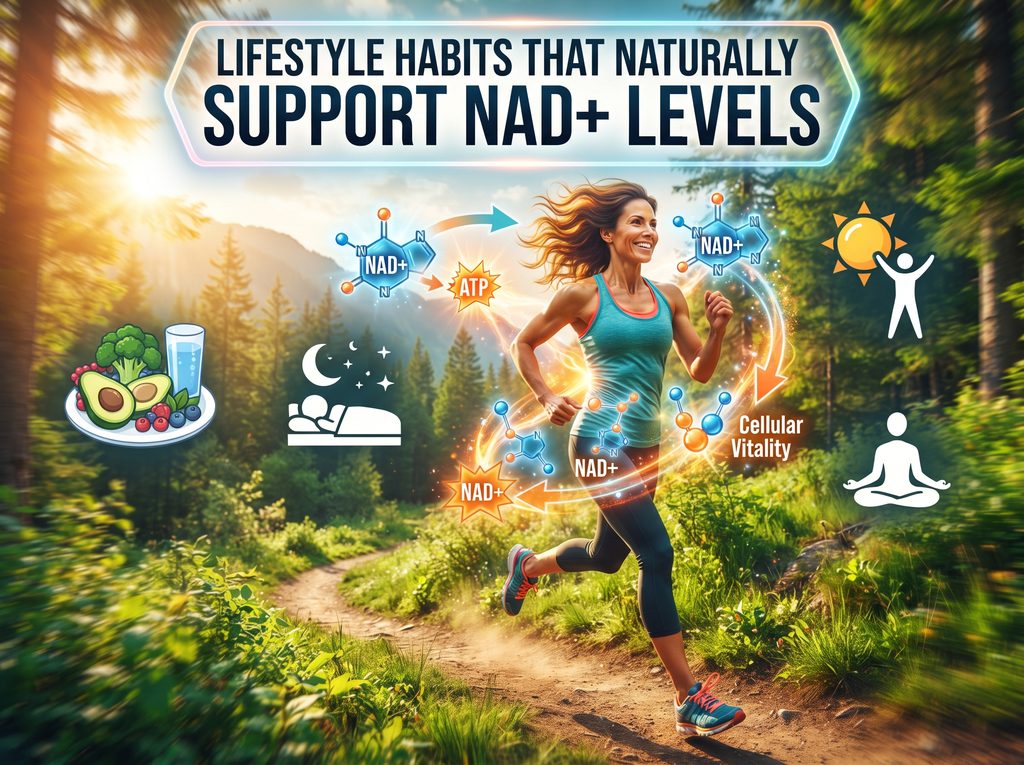
6. Lifestyle Habits That Naturally Support NAD+ Levels
Supplementation is not the only way to support cellular NAD+ pools. Everyday lifestyle factors stimulate the enzymes responsible for creating NAD+ while curbing unnecessary depletion.
- Regular Physical Exercise: Both aerobic interval training and resistance training upregulate NAMPT (nicotinamide phosphoribosyltransferase), the rate-limiting enzyme in the NAD+ salvage pathway.
- Intermittent Fasting & Caloric Moderation: Mild nutrient scarcity activates cellular energy sensors like AMPK, which stimulates NAD+ synthesis to prepare cells for stress.
- Circadian Rhythm Alignment: NAD+ production is under direct control of the core molecular clock. Maintaining consistent sleep-wake cycles preserves the natural 24-hour oscillation of NAD+ synthesis.
- Dietary Polyphenols: Compounds such as apigenin (found in parsley and chamomile) and quercetin inhibit CD38, a cell-surface enzyme that accounts for a substantial portion of NAD+ degradation during aging.
7. Safety, Nuance, and What Research Hasn’t Solved Yet
While the safety profile of common NAD+ precursors (NR and NMN) across short- and medium-term trials is favorable, several scientific questions remain unanswered:
- No Direct Lifespan Data in Humans: Because human lifespan studies take decades, science cannot claim that raising NAD+ extends human longevity; the primary clinical focus is on healthspan and physiological biomarkers.
- Individual Variability: Baseline NAD+ levels, age, metabolic health, and genetic differences influence how efficiently a person absorbs precursors and synthesizes NAD+.
- Optimized Dosing: Research is actively determining the most effective dosages and timing protocols for specific health goals rather than a one-size-fits-all approach.
Frequently Asked Questions
Can I just take pure NAD+ pills instead of precursors?
Oral intact NAD+ has poor bioavailability because gastric enzymes rapidly degrade it into smaller components during digestion. Precursors like NR or NMN are better equipped to enter cells and be converted into functional NAD+ internally.
What is the primary difference between NAD+ and NADH?
NAD+ is the “empty” electron carrier, ready to accept electrons from food metabolism, while NADH is the “loaded” version carrying electrons to generate ATP in mitochondria. The ratio of NAD+ to NADH is a primary indicator of cellular metabolic health.
Are there side effects associated with NAD+ precursors?
In clinical trials up to 1,000–2,000 mg daily, NR and NMN have generally been well-tolerated. Mild, infrequent side effects include minor gastrointestinal discomfort, headache, or fatigue. As with any wellness protocol, consult a healthcare professional before starting new regimens.
The Vitaminspoon Takeaway
NAD+ is a foundational biochemical driver of cellular energy, DNA maintenance, and metabolic regulation that naturally declines with age. While emerging research into longevity supplements like NR and NMN shows great promise in safely elevating NAD+ biomarkers, the most reliable way to preserve your cellular health today remains rooted in consistent aerobic exercise, balanced nutrition, quality sleep, and smart stress management.