

Aging is a natural biological process driven by the gradual accumulation of cellular damage over time, leading to declines in physiological function and resilience. Understanding the science behind these mechanisms allows us to support cellular health and promote healthy aging, helping us sustain physical and cognitive vitality throughout life.
For decades, getting older was viewed as an uncontrollable, passive decline. Today, researchers in geroscience understand that aging is driven by specific biological pathways. By learning how our cells change over time, we can make informed, evidence-based choices to maintain vitality without buying into sensationalized “anti-aging” promises.
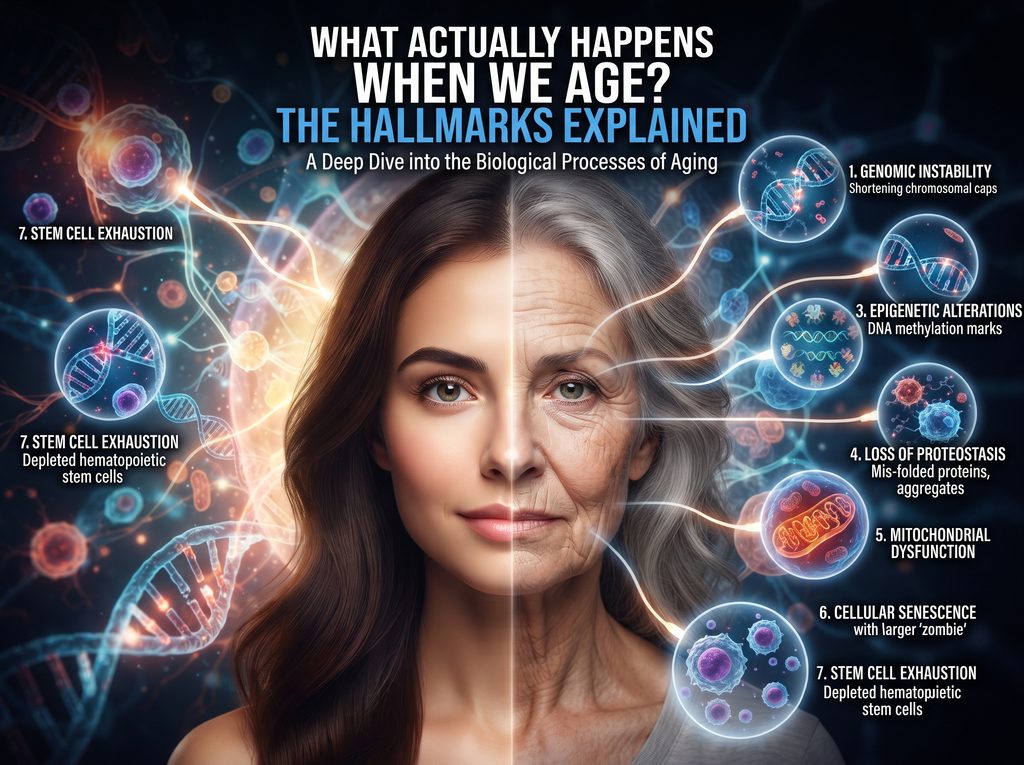
1. What Actually Happens When We Age? The Hallmarks Explained
At its core, aging is cellular. As we move through decades of life, our cells perform billions of chemical reactions, divide repeatedly, and defend against environmental stressors. Eventually, this constant activity leaves biological traces known in scientific literature as the Hallmarks of Aging.
Daily Metabolic Work & Stressors
               │
               ▼
Cumulative Cellular Strain (DNA damage, telomere shortening)
               │
               ▼
Reduced Repair Capacity & Senescent Cell Accumulation
               │
               ▼
Gradual Physiological Decline (The Aging Process)
Key cellular drivers of aging include:
- Genomic Instability: Environmental factors (like UV light and pollutants) and natural internal metabolic processes create tiny breaks in our DNA over time. Although cells possess intricate repair pathways, some errors gradually escape detection.
- Telomere Attrition: Telomeres are protective caps on the ends of chromosomes. Each time a cell divides, these caps shorten slightly. Once they reach a critically short length, the cell stops dividing.
- Mitochondrial Dysfunction: Mitochondria produce the ATP that powers cellular life. Over time, their performance dips, creating more reactive oxygen species (ROS) and less efficient energy output.
- Loss of Proteostasis: Cells rely on mechanisms to fold, maintain, and clear proteins. When these mechanisms slow down, misfolded proteins can build up and impair normal cellular function.
2. Cellular Senescence and “Inflammaging”
When cells experience significant stress or their telomeres become excessively short, they often enter a state called cellular senescence.
Senescent cells permanently cease dividing, but they do not quietly die off. Instead, they remain metabolically active and secrete a mixture of pro-inflammatory cytokines, chemokines, and tissue-remodeling enzymes known as the Senescence-Associated Secretory Phenotype (SASP).
In youth, the immune system swiftly clears these senescent cells. As immune surveillance naturally slows with age, senescent cells can accumulate in tissues. The continuous low-grade signaling from SASP contributes to “inflammaging”—a chronic, sterile background inflammation that strains surrounding healthy cells and tissues.
3. Epigenetics: The Software of Longevity
While your DNA sequence represents the static hardware of your biology, your epigenome acts as the software. It consists of chemical tags (such as methyl groups) that tell specific genes when to turn on or off.
As we age, epigenetic marks experience shifts—a phenomenon known as epigenetic drift. Key longevity-associated enzyme families, like sirtuins, help manage these epigenetic settings while regulating DNA repair and metabolic efficiency. Supporting healthy epigenetic regulation through lifestyle habits is one of the most dynamic areas of longevity research today.
4. The Longevity Diet: Fueling Cellular Maintenance
Nutrition directly communicates with our longevity pathways through nutrient-sensing networks such as mTOR, AMPK, and sirtuins.
A well-structured longevity diet focuses on nutrient density, metabolic flexibility, and moderate energy balance:
Principles of a Science-Backed Longevity Diet
- Abundant Polyphenols: Colorful plants supply compounds like quercetin, resveratrol, and anthocyanins that support antioxidant defense networks and activate cellular stress-response pathways.
- Complex Fiber and Microbiome Support: Soluble and insoluble fibers feed gut bacteria, yielding short-chain fatty acids (SCFAs) like butyrate, which maintain the gut barrier and support healthy inflammatory balance.
- Strategic Protein Distribution: Adequate dietary protein preserves lean muscle mass—a critical metric for longevity—while avoiding excessive, chronic spikes in growth pathways.
- Time-Restricted Eating: Giving the digestive system a daily rest window (such as 12 to 14 hours overnight) encourages autophagy, the cellular process of cleaning out and recycling worn-out components.
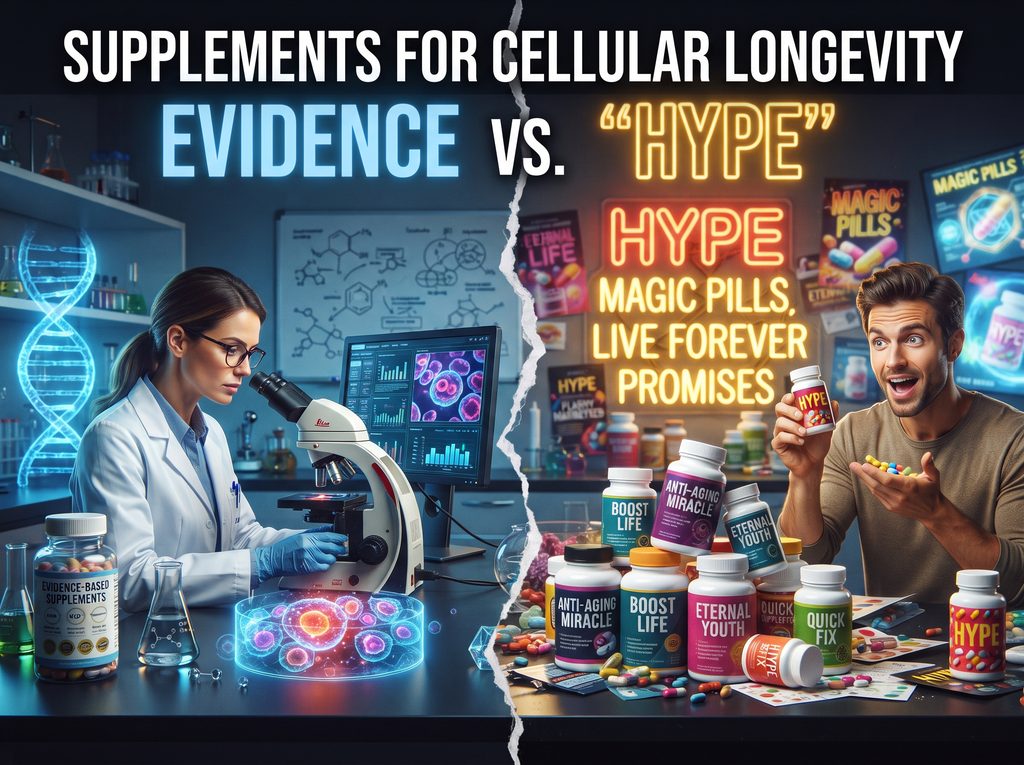
5. Supplements for Cellular Longevity: Evidence vs. Hype
The market for longevity supplements is rapidly expanding. While preclinical models show exciting promise, it is essential to look closely at what human trials have verified versus what remains emerging science.
| Category | Primary Compound(s) | Established Human Evidence | Emerging Lab & Animal Research |
| NAD+ Precursors | NR (Nicotinamide Riboside), NMN | Safely raises systemic NAD+ levels; supports healthy cellular energy biomarkers. | Increases healthspan and mitochondrial vitality in animal models. |
| Cellular Clearing | Quercetin, Fisetin (Senolytics) | Demonstrates general safety and antioxidant properties in humans. | Selectively targets senescent cells in mice to improve tissue function. |
| Mitochondrial Support | CoQ10, Alpha-Lipoic Acid | Well-documented support for cardiovascular cellular energetics. | Synergistic defense against chronic oxidative damage. |
| Autophagy Activators | Spermidine, Resveratrol | Recognized as safe; supports general cardiovascular and cellular metrics. | Promotes cellular self-cleaning and proteostasis in model organisms. |
Note: Dietary supplements should complement—not replace—evidence-based lifestyle fundamentals.
6. Daily Pillars to Support Healthy Aging
Technology and targeted compounds offer fascinating possibilities, but clinical evidence consistently shows that everyday habits provide the strongest foundation for long-term healthspan.
       ┌─────────────────────────────────────────────────┐
       │             FOUNDATIONS OF LONGEVITY            │
       └─────────────────────────────────────────────────┘
         │                      │                      │
   [ Movement ]           [ Restoration ]        [ Nutrition & Mind ]
   • Zone 2 Cardio        • 7-9 hrs Sleep        • Whole-food diet
   • Resistance Work      • Sleep Architecture   • Chronic stress reduction
   • VO2 Max conditioning • Circadian Rhythm     • Social connection
- Cardiovascular & Resistance Exercise: Combining strength training (to protect bone density and muscle mass) with aerobic exercise improves mitochondrial density, insulin sensitivity, and vascular health.
- Restorative Sleep: Deep and REM sleep stages enable the glymphatic system to clear metabolic waste from the brain and allow tissues to undergo vital structural repair.
- Stress Modulation: Chronic psychological stress elevates baseline cortisol and accelerates cellular wear. Practices like breathwork, time in nature, and active social connection support nervous system regulation.
Frequently Asked Questions
Can aging actually be “reversed”?
Current biological evidence does not support claims that human aging can be reversed. Science instead focuses on optimizing healthspan—the proportion of life spent in good health and physical independence—by slowing the rate of cellular damage and preserving physiological resilience.
What is the difference between chronological age and biological age?
Chronological age is simply the number of calendar years since birth. Biological age reflects the physiological condition of your cells, tissues, and organ systems, which can be influenced by genetics, environment, and daily lifestyle choices.
When should someone start focusing on healthy aging?
Cellular changes occur gradually throughout adulthood. Adopting foundational habits—such as consistent physical activity, balanced nutrition, and restorative sleep—supports cellular health across your 20s, 30s, 40s, and beyond.
The Vitaminspoon Takeaway
Aging is not a single breakdown, but a complex biological process shaped by how well our cells generate energy, manage repair, and respond to stress. While the science of longevity supplements and cellular pathways is rapidly advancing, the most reliable tools for healthy aging remain grounded in balanced nutrition, regular physical movement, quality rest, and active stress management.